
Four Lessons From Twenty Years of Connecting Business Systems
I have spent more than twenty years helping companies get their systems to work together. CRM, ERP, finance, payroll, analytics. Different companies, different industries, different tools.
The technology changed a lot over those years. The problems did not.
At Scalesology, we kept getting the same phone calls. A report nobody trusted. An integration that broke when someone left. A new acquisition that meant starting over. We solved those problems one custom project at a time, until we realized we were solving the same problems again and again, and decided to solve them once.
So here are the lessons that led us there, and what I wish someone had shared with me on day one.
- An integration is only as durable as the person who built it
Many companies run on connections that live in one person’s head. The scripts work, the data moves, and everyone assumes it will keep working.
Then that person takes a new job. The documentation, if there was any, goes with them. The next small change turns into a project, and the project turns into a fire drill.
Integration should not depend on one person’s memory. It should be documented, monitored and owned by a team whose job is to keep it running.
- Every new system should not mean starting over
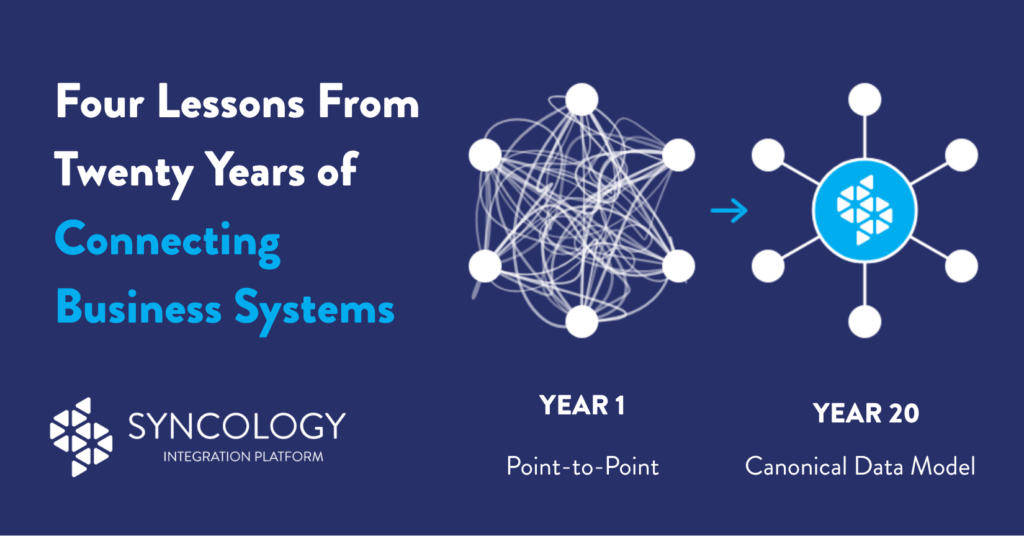
Most integrations are built point to point. System A talks to System B. System B talks to System C. It works, until you add System D.
At that point, your architecture diagram starts to look less like a plan and more like a plate of spaghetti.
Now every existing connection needs to be revisited. Add an acquisition that runs a different ERP, and the rewiring multiplies.
There is a better pattern. When each system syncs once to a shared canonical data model, a customer, an invoice or a vendor means the same thing everywhere. A new system or a new entity connects to that model one time, and nothing else has to be rebuilt.
- Connected is not the same as trusted
It is a familiar scene in a lot of leadership meetings. Two people bring two different numbers for the same thing. Both pulled them from systems that are “integrated.” Each number is correct according to its own source. They cannot both be right.
The meeting ends with a third number and another meeting on the calendar.
The problem is not the connection. It is the lack of governance. Nobody can say exactly where each number came from, who changed it, or who is allowed to see it.
Connected is good. Governed is better. When you can trace data from its source to its target, set approvals where they matter and control access down to the field, the conversation shifts from “Which number is right?” to “What do we do about it?”
- Your AI strategy is only as good as your data controls
Most leaders I talk to fall into one of two camps. Some want AI working on real business data now. Others do not feel ready for it personally, but they know the business could fall behind without it.
Both instincts are valid.
And the people responsible for the company’s data are caught in the middle: asked to say yes to AI, and accountable if something sensitive ends up where it should not.
So many companies are stuck. Ban AI, and people use it anyway on personal accounts, and nobody knows what is being shared. The risk is AI with no limits and no record.
Before AI can help, you need to decide what it is allowed to see, mask what is sensitive, and keep a record of every request. With those controls in place, saying yes to AI becomes a deliberate business decision instead of a gamble.
Why we built Syncology
Those four lessons are the reason Syncology exists.
Syncology is a governed integration platform, delivered as a managed service by Scalesology. It syncs your systems through one canonical data model, governs every record as it moves, and gives you an AI Control Center to decide exactly what AI can see.
And our team runs it. An account manager, project manager and technical lead (from the team that designed the platform) set it up on your terms and keep it running. Your people can focus on running the business instead of babysitting the plumbing.
We built it so our clients would not need a custom project every time their systems change. After twenty years, the lesson I most wish I had learned sooner is that you should not have to solve the same problem twice.
Your systems are telling you something
If any of these sound familiar, your systems are trying to get your attention.
Book a demo, and we will show you how Syncology helps you sync every system, trust every record and keep AI controlled, using the challenges your team faces today.